
|
Getting your Trinity Audio player ready...
|
By: Samuel Asamoah
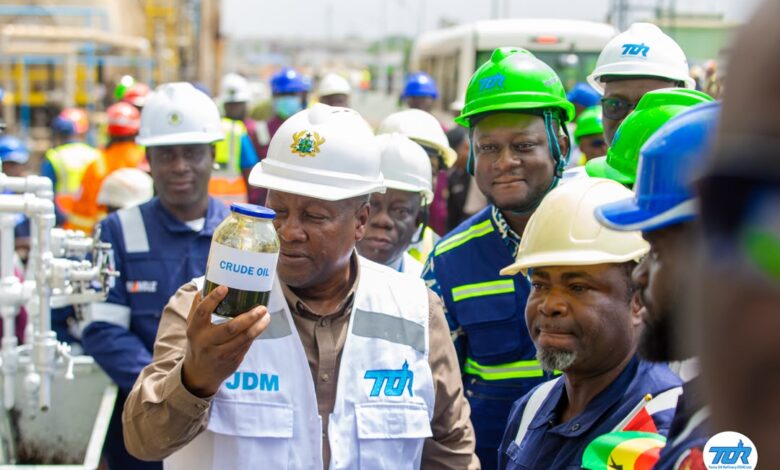
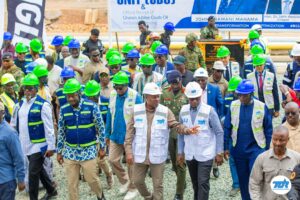
President John Dramani Mahama has commissioned the refurbished key refining units of the Tema Oil Refinery (TOR), declaring the state-owned refinery fully operational once again and positioning it as the cornerstone of Ghana’s ambition to become a petroleum refining hub for West Africa.
The commissioning ceremony, held at the refinery in Tema, also marked the successful receipt and processing of one million barrels of indigenous Jubilee Medium Sweet Crude, the latest of three one-million-barrel crude shipments received by TOR since May this year.
Speaking at the event, President Mahama described the revival of TOR as the fulfilment of a key campaign promise, insisting that Ghana could not afford to abandon one of its most strategic national assets.
“There were those who believed the refinery had outlived its usefulness and should be sold. But nations do not build prosperity by abandoning strategic national assets whenever they face adversity. You restore them, strengthen them and make them work again,” he said.
The President formally commissioned the rehabilitated Crude Distillation Unit (CDU), the Residue Fluid Catalytic Cracking (RFCC) Unit, Boiler Number Eight, the newly installed F-61 Crude Heater, refurbished reception area, renovated staff canteen and other upgraded facilities.
According to him, the refinery has progressively restored its processing capacity, with the new crude heater expected to increase throughput from about 28,000 barrels per stream day towards its original design capacity of 45,000 barrels, with the potential to reach 60,000 barrels.
Mr. Mahama said the revival of TOR goes beyond engineering achievements, describing it as a major national development and industrialisation project aimed at strengthening Ghana’s energy security, reducing dependence on imported petroleum products and conserving foreign exchange.
He announced that government had deliberately allocated Ghanaian-produced Jubilee crude to the refinery as a strategic policy decision.
“Ghanaian crude should create Ghanaian jobs, support Ghanaian industries and create value within the Ghanaian economy before leaving our shores,” he stated.
The President said every barrel refined locally would reduce the country’s import bill while supporting fishing communities through premix fuel, strengthening aviation with locally produced aviation fuel and expanding access to liquefied petroleum gas for households.
He further linked the refinery’s return to operation to broader economic improvements, citing declining inflation, improving macroeconomic stability and renewed investor confidence.
Mr. Mahama noted that TOR had returned to profitability for the first time in almost a decade, attributing part of the improvement to gains arising from the appreciation of the Ghana cedi.
He, however, cautioned management and staff against complacency, stressing that the challenge now was sustaining efficient, safe and profitable operations.
“Today’s applause will fade, the cameras will leave and the speeches will end. But these plants must continue operating safely and efficiently next week, next month and next year,” he said.
The President reiterated government’s long-term vision of transforming Ghana from a crude oil producer into a major refining and petroleum processing centre capable of exporting value-added petroleum products across the ECOWAS sub-region.
Earlier, Minister for Energy and Green Transition, Dr. John Abdulai Jinapor, described the commissioning as the restoration of confidence in one of Ghana’s most important strategic institutions.
He said TOR had served as the backbone of Ghana’s downstream petroleum industry for more than six decades, making its recovery critical to national industrialisation, energy security and economic growth.
Dr. Jinapor credited the refinery’s turnaround to clear government policy, sound leadership, prudent financial management and the dedication of engineers, technicians and management.
He said government remained committed to transforming TOR into a modern, commercially competitive and financially sustainable refinery capable of serving both Ghana and the wider West African market.
According to him, the Ministry of Energy and Green Transition would continue implementing policies to attract investment, strengthen corporate governance, improve operational efficiency and promote local content within the downstream petroleum sector.
In his welcome address, Managing Director of Tema Oil Refinery, Edmond Kombat, said the commissioning marked not merely the revival of equipment but the restoration of national confidence in Ghana’s only state-owned refinery.
He disclosed that the refinery resumed operations in December 2025 after extensive turnaround maintenance and has since successfully processed three separate one-million-barrel crude cargoes, including Ghana’s indigenous Jubilee Medium Sweet Crude.
Mr. Kombat also revealed that TOR recorded a profit before tax exceeding GH¢1 billion for the 2025 financial year after nearly a decade of continuous losses, attributing the turnaround to improved financial discipline, operational efficiency and institutional reforms.
He said the refinery’s restoration had generated significant employment opportunities, with 1,542 Ghanaians benefiting from permanent and temporary jobs through rehabilitation works, while 300 young engineers had been recruited to build the next generation of refining professionals.
The Managing Director said TOR’s long-term ambition is to become one of the most competitive refineries in West Africa and serve as the preferred refinery within the ECOWAS sub-region.