
|
Getting your Trinity Audio player ready...
|
By Samuel Asamoah
Religious institutions across The Gambia are being urged to strengthen financial transparency and accountability amid concerns that charitable platforms and donations could be exploited for money laundering and terrorist financing.
The Inter-Governmental Action Group against Money Laundering in West Africa (GIABA) and The Gambia’s Financial Intelligence Unit (FIU) say religious leaders have a critical role to play in preventing the misuse of churches, mosques and other faith-based organisations for illicit financial activities.
The warning formed part of a renewed national campaign to engage religious leaders in the fight against money laundering and terrorist financing, with authorities stressing that the threat goes beyond banks and financial institutions and requires action across society.
Speaking at a two-day national sensitisation seminar for religious leaders and institutions in Banjul, the FIU Director and GIABA National Correspondent said religious organisations command significant public trust and manage donations, zakat, Sadaqah and other charitable funds, making transparency and accountability essential safeguards against potential abuse.
He, however, cautioned against portraying religious organisations as inherently vulnerable to financial crimes, saying the objective was to equip them with the knowledge and systems needed to protect their institutions and resources.
“Transparency protects trust. Accountability protects institutions. And responsible financial management protects communities,” he said.
He called on religious institutions to know the sources of significant donations, maintain proper financial records, ensure transparency in the management of funds and exercise caution when receiving money from external sources.
The intervention comes as West African countries continue to confront predicate offences associated with money laundering, including corruption, kidnapping, human and drug trafficking and violent extremism.
The Director General of GIABA, Mam Cherno Jallow, said the growing threat required religious and opinion leaders to become active partners in efforts to protect communities and strengthen regional security.
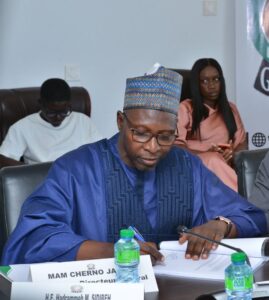
In remarks delivered on his behalf by GIABA’s Acting Principal Officer for Communication and Advocacy, Tim Melaye, Mr Jallow said religious leaders must use their influence to speak against violent extremism, terrorism, corruption, human trafficking and kidnapping while promoting responsible and exemplary lifestyles.
He said the engagement was intended to move religious leaders beyond awareness creation and towards practical action capable of helping to build a safer and economically viable West Africa.
The Gambian Government has also framed the fight against money laundering and terrorist financing as a national responsibility rather than an assignment for the FIU, police, banks and other state institutions alone.
The Minister of Lands, Regional Governments and Religious Affairs, who declared the seminar open on behalf of the government, said illicit financial flows have consequences for the economy, national security, governance, social stability and the country’s international reputation.
He urged religious leaders to make anti-money laundering and counter-terrorist financing awareness part of their regular engagement with congregations through mosques, churches, Islamic schools and community platforms.
He further called on religious institutions to strengthen their internal financial controls, citizens to report suspicious activities and state agencies to deepen collaboration with faith-based organisations.
The Minister said the effectiveness of the initiative would ultimately depend on whether participants translate the lessons into concrete measures within their institutions.
The engagement, themed “Promoting AML/CFT on the Altar,” is the second such programme organised in The Gambia following the maiden edition in 2019 under GIABA’s targeted religious leaders programme established in 2017.
GIABA says its broader mandate is to support West African states in implementing international anti-money laundering and counter-terrorist financing standards while monitoring emerging financial crime trends and strengthening the capacity of national Financial Intelligence Units.
The current engagement is expected to focus on practical issues including risks facing non-profit organisations, the role of religious sermons in promoting tolerance and preventing violent extremism, and financial safeguards that religious institutions can adopt without imposing disproportionate administrative burdens.
For authorities, the central message is that protecting religious institutions from financial abuse is also about protecting public trust, community resources and national security.