
|
Getting your Trinity Audio player ready...
|
By: Edward Graham Sebbie
Residents along Ghana’s eastern shoreline are breathing a sigh of relief as a new nature-based initiative begins work to protect their communities from further destruction by the sea.
The project has become urgent after three decades of mangrove depletion, a key natural barrier that once shielded the coast from erosion and floods.
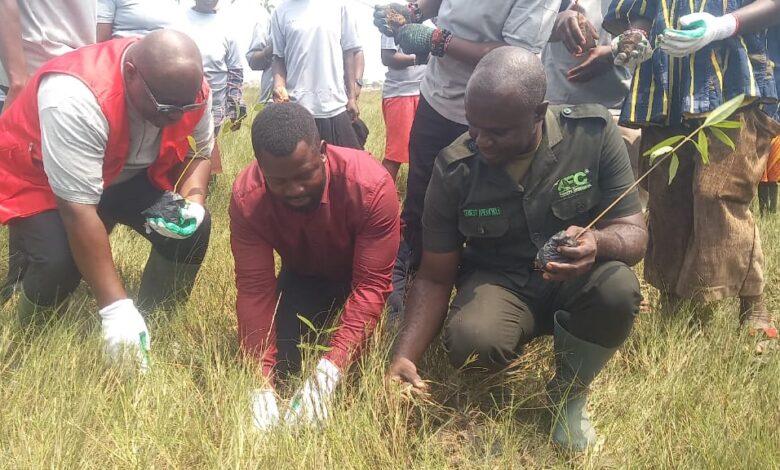
The “Mangrove Restoration Project,” being implemented by ActionAid Ghana with funding from the Adaptation Fund, aims to revive the region’s coastal vegetation in the project which focus on planting mangroves in Ada and Anglo areas across the Greater Accra and Volta Regions.
Beneficiary communities include Wokumagbe, Goi, Kewunor, Akplabanya, Atiteti, Woe, Vuti, Tegbi, and Dzita.
Launching the initiative to also mark the World Mangroves Day at Wokumagbe in West AdaDistrict, Justin Bayor, Head of Programmes at ActionAid Ghana, described Ada as one of the worst-affected areas.
“Ada, both East and West, have been badly impacted by floods over the years. There is total depletion of mangroves in this area,” he said. “So when we look around, there was a clear need for intervention and It couldn’t cover all communities, but specific ones of which Akplabanya, Wokumagbe, and Goi are part.”
Mr. Bayor disclosed that 15 hectares of coastal vegetation will be restored in West Ada, with a total of 410 hectares targeted across the nine communities in both regions. He also stressed the need for community education on the value of mangroves.
“We will continue to sensitize the communities to ensure they do not harvest these mangroves at will because they are for their own protection. We need to let them know the importance of mangroves in mitigating climate change as far as their communities are concerned.”

Looking ahead, Mr. Bayor said the project will explore partnerships to enable communities to access the carbon market from the 410 hectares being restored.
“As part of the project, we will educate them on what the carbon market is about so that people can do it on their own and earn income even after the project ends,” he added.
Lawrence Katey Nunekpeku, Presiding Member of the West Ada District Assembly, used the occasion to correct the perception that mangrove harvesting alone caused the depletion. He said tidal waves and sea erosion are the major drivers.
He pledged the Assembly’s support and said members would work to replicate the initiative in other areas, including around the Songor Lagoon and other internationally recognized wetlands that host migratory birds.
On economic benefits, Mr. Nunekpeku noted: “Where there are mangroves, there are fish, shrimps, and crabs, offering sources of income to residents through fishing.” He also emphasized restoring wetlands to prevent further loss of wildlife.
The Chief of Wokumagbe, Nene Adjorkey Siaw VII, welcomed the intervention, saying it could open other employment avenues. He assured full community support to protect the young mangroves until they mature.
The chief also called for sustained education.
“Some of us don’t know the significance of mangroves, but with continued education, I hope we come to understand that mangroves are tied to the continuous existence of our community.”
The restoration project, along with other social interventions, was necessitated by the fast-eroding eastern coast of Ghana following the loss of mangroves — a critical protective vegetation.
Beyond protecting communities from the Atlantic Ocean, the project is also expected to provide temporary income streams for residents, especially women, during the planting and maintenance phases.