
CONIWAS Raises Concern Over WASH Funding Shortfall, Weak Coordination and Growing Rural-Urban Inequality

|
Getting your Trinity Audio player ready...
|
By: Samuel Asamoah
The Coalition of NGOs in Water and Sanitation (CONIWAS) has raised concerns over declining government budgetary allocations and weak institutional coordination in Ghana’s Water, Sanitation and Hygiene (WASH) sector, warning that the situation threatens progress towards universal access to basic services.
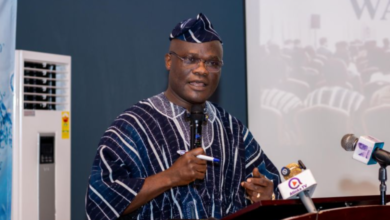
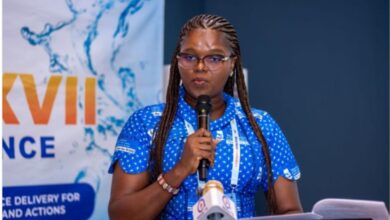
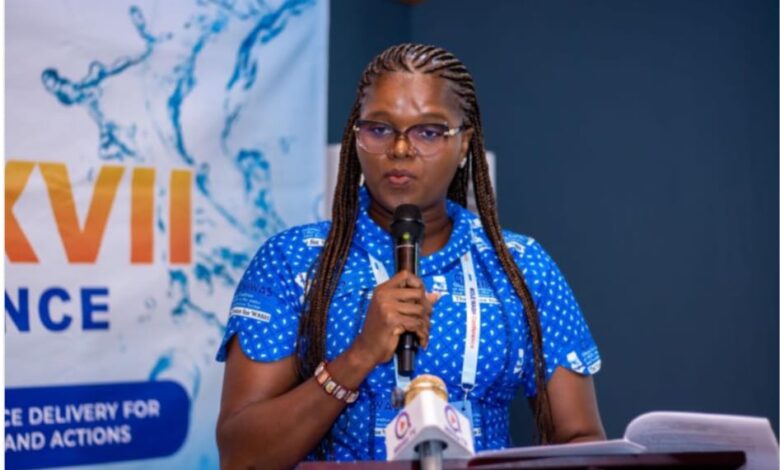
Chairperson of CONIWAS, Dr. Beata Awinpoka Akanyani, said the Joint WASH Sector Working Group, the sector’s principal coordination platform, had not met since January 2025, raising concerns about effective oversight and stakeholder engagement.
Delivering her welcome address at the MOLE XXXVII Conference in Ada, she cited figures showing that WASH’s share of the national budget declined from 0.81 per cent in 2023 to 0.29 per cent in 2024.
She said budgetary allocations stood at GH¢741 million in 2024 and GH¢544 million in 2025, while the estimated annual financing requirement of US$1.7 billion left the sector facing a substantial funding deficit.
Dr. Akanyani cautioned that budgetary allocations should not be confused with actual releases and expenditure, stressing the need for greater transparency and accountability in public financing.
She also highlighted persistent inequalities in access to WASH services, noting that one in four rural residents lacked access to basic water services, while only 17 per cent had safely managed water.
Rural access to basic hygiene, she said, had declined from 36 per cent in 2015 to 31 per cent in 2024, while open defecation remained significantly higher in rural communities at 31.3 per cent, compared with 8.9 per cent in urban areas.
She further disclosed that 74 per cent of households lacked exclusive access to an improved toilet facility, warning that the current rate of progress in basic sanitation would leave Ghana far short of universal access by 2030.
Although acknowledging government interventions, including the allocation of 20 per cent of the Common Fund to WASH, the €323 million Northern Ghana Water Project and sanitation operations at Agbogbloshie, she said several critical policy and institutional reforms remained outstanding.
These include the proposed Sanitation Authority Bill, which is still before Cabinet, the revised Environmental Sanitation Policy and inadequate resources for Environmental Health Units.
Dr. Akanyani called for the immediate reconvening of the Joint WASH Sector Working Group, a statutory framework for civil society participation, a multi-year domestic investment plan and transparent reporting on the utilisation of Common Fund allocations by Metropolitan, Municipal and District Assemblies.
She stressed that civil society organisations must be recognised as essential partners in sector governance rather than engaged only during emergencies.
The MOLE XXXVII Conference brings together WASH professionals, policymakers, development partners, civil society organisations and journalists to examine challenges confronting the sector, with particular attention to climate resilience, sustainable financing, accountability and equitable access to water, sanitation and hygiene services.