
IEAG warns Ghana risks losing import trade to neighbouring ports over congestion


|
Getting your Trinity Audio player ready...
|
By: Samuel Asamoah
The Executive Secretary of the Importers and Exporters Association of Ghana (IEAG), Samson Asaki Awingobit, has called for urgent government intervention to tackle worsening congestion and operational bottlenecks at Ghana’s ports, warning that the country risks losing import trade to competing ports in neighbouring countries.
Addressing the media on Monday, September 14, 2026, Mr. Awingobit said the situation at the ports had reached a critical stage and required immediate, coordinated action at the highest level of government.
He called on the Chief of Staff at the Presidency to convene and lead a high-level emergency engagement involving the Ministers of Finance, Trade, Agribusiness and Industry, and Transport, together with the relevant port and regulatory agencies.
According to Mr. Awingobit, IEAG’s assessment, based on engagements with importers, freight forwarders, customs house agents, transport operators and other stakeholders, indicates that the congestion is systemic and cannot be blamed on one institution alone.
He identified customs valuation and examination processes, inspection protocols, regulatory charges, terminal operations, truck turnaround times and weak inter-agency coordination as some of the factors contributing to the problem.
74 percent red-routing claim
Mr. Awingobit raised particular concern over what he described as the excessive routing of containers for physical and intrusive examination.
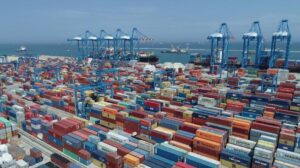
He said preliminary information available to the Association suggests that approximately 74 percent of containers undergoing scanning are being routed to the red channel for physical examination.
Although he stressed that the figure requires independent verification, he said confirmation of the figure should trigger an immediate management and operational review of Customs’ risk-profiling system.
He acknowledged the need for Customs to examine high-risk cargo to protect state revenue and prevent smuggling, under-valuation, misclassification and other customs offences.
However, he cautioned that a system that routinely subjects an exceptionally high proportion of cargo to intrusive examination could itself become a major source of congestion.
Multiple inspections worsening delays
The IEAG Executive Secretary also accused some regulatory agencies of failing to consistently participate in coordinated inspections at the ports.
He said where a container requires intervention from multiple agencies, the inspection should be coordinated to avoid subjecting importers to successive examinations.
According to him, reports received by the Association indicate that some agencies allegedly appear only after Customs has completed its inspection, resulting in containers being dropped again for separate examination.
Mr. Awingobit said the practice creates additional truck movements, handling costs and delays in cargo clearance.
He further disclosed allegations that some operators are being asked to make unofficial payments of up to GH¢1,000 to avoid additional inspections.
He stressed that the allegations must be independently investigated, but warned that if established, such practices would undermine Ghana’s trade facilitation agenda and the integrity of the port clearance system.
Regulatory charges under scrutiny
Mr. Awingobit also criticised what IEAG considers significant increases in regulatory, inspection, certification and processing fees imposed by agencies operating at the ports.
He mentioned the Ghana Standards Authority, Food and Drugs Authority and Environmental Protection Agency among the institutions whose charges are contributing to the concerns of importers.
He said the issue was not only the individual fees but their cumulative impact on consignments requiring clearance from multiple agencies.
According to him, delays arising from disputed assessments, regulatory approvals and other processes increase cargo dwell time and expose importers to additional demurrage, storage, detention and logistics costs.
Truck turnaround times
The IEAG Executive Secretary further raised concerns over prolonged truck turnaround times at some terminals.
He said transport operators had reported reluctance among some drivers to undertake jobs involving particular shipping-line terminals because of reportedly excessive waiting times.
He cited MSC-operated container-handling facilities as an example.
Mr. Awingobit said long turnaround times reduce the effective capacity of the national haulage fleet, increase operating costs and contribute to the accumulation of uncleared containers.
He therefore urged government to examine the entire cargo evacuation chain, from vessel discharge and terminal handling through customs clearance, examination, truck appointment, loading and exit.
Ghana could lose cargo to Abidjan
Mr. Awingobit warned that the port congestion was no longer simply an operational challenge but had become a threat to Ghana’s trade competitiveness.
He said the situation could worsen as the country approaches the December peak trading period, with importers potentially facing higher cargo dwell times, storage charges, demurrage and other operational costs.
More worrying, he said, was the indication that some importers were already considering routing their cargo through the Port of Abidjan in Côte d’Ivoire because of delays and uncertainties associated with clearing cargo through Ghana’s ports.
Mr. Awingobit cautioned that once importers establish alternative supply chains through competing regional ports, it could become difficult for Ghana to win back that business.
IEAG demands emergency intervention
Mr. Awingobit reiterated IEAG’s call for the Chief of Staff to lead an emergency meeting involving the Ministers of Finance, Transport and Trade, heads of relevant state institutions and other stakeholders within the port ecosystem.
The Association is also proposing measurable performance targets for port operations, including maximum turnaround times for examinations, valuation disputes, regulatory inspections, truck processing and cargo release.
Mr. Awingobit said every agency operating within the port ecosystem must be accountable for the amount of time its processes add to the cargo clearance chain.
He warned that failure to act immediately could leave Ghana confronting not only severe congestion during the December trading period but also the more difficult task of winning back importers who have shifted their cargo and supply chains to competing ports.