
|
Getting your Trinity Audio player ready...
|
By: Samuel Asamoah
The climate crisis in northern Ghana is increasingly becoming a livelihood crisis, and Water, Sanitation and Hygiene (WASH) journalists are preparing to put the growing threat at the centre of national discourse.
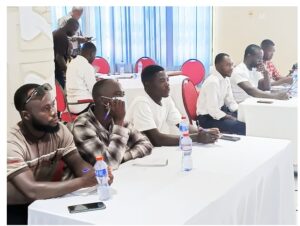
Following a three-day training on climate change reporting in Bolgatanga, journalists from across northern Ghana have been equipped to investigate how prolonged dry seasons, erratic rainfall, flooding and declining water resources are undermining farming, livestock production, household incomes and public health.
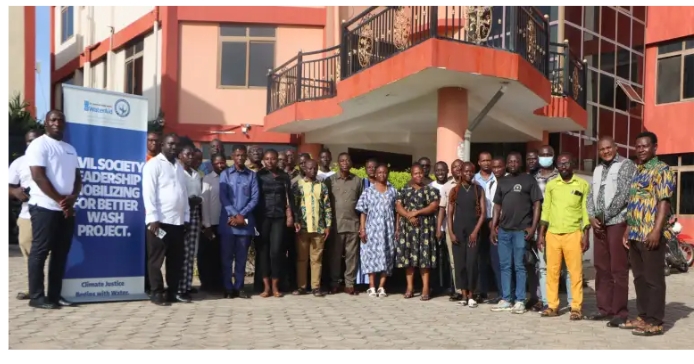
The training, organised by the Belim Wusa Development Agency (BEWDA) in partnership with WaterAid Ghana under the SIDA CLIMB Better WASH Partnership, brought together 30 journalists working in the WASH sector.
The programme was designed to strengthen the capacity of journalists to move beyond conventional reports on weather events and produce evidence-based stories that demonstrate the human and economic consequences of climate change on vulnerable communities.
Turning climate change into a human story
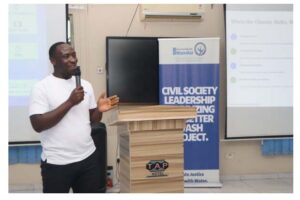
National Coordinator of the Ghana WASH Journalists Network, Justice Lee Adoboe, urged the journalists to make livelihoods a central component of climate reporting.
He challenged them to investigate how changing weather patterns are affecting livestock, particularly the availability of pasture and water, while also examining the impact on crop production and aquatic life.
Mr Adoboe said journalists should ask not only how much rainfall a community received, but what that rainfall — or lack of it — meant for farmers, livestock owners, businesses and families.
He identified declining fish stocks, disrupted local businesses and climate-induced migration as other areas requiring deeper journalistic investigation.
According to him, connecting climate change to everyday experiences would make the subject more relevant to audiences and help demonstrate that climate change is not merely an environmental issue but one directly linked to food, water, income and survival.
Five Upper East districts facing growing climate pressures
The renewed focus is particularly significant for Bongo, Nabdam, Bawku West, Kassena-Nankana West and Kassena-Nankana Municipality, where climate vulnerability assessments have highlighted significant pressures on water resources and livelihoods.
A WaterAid Ghana climate vulnerability and resilience assessment identified changes in rainfall patterns, declining water availability and reduced groundwater recharge among the challenges confronting communities in the five areas.
The findings have informed interventions aimed at strengthening climate-resilient WASH systems and improving communities’ capacity to cope with increasing climate pressures.
The effects are particularly pronounced during the dry season.
In Bongo, worsening water scarcity has increased the burden on women who spend more time searching for water, potentially reducing the time available for farming, trading and other economic activities.
In Nabdam, about 55 per cent of households reportedly lack access to safe drinking water during the dry season, highlighting the severity of seasonal water insecurity and its implications for households, agriculture and livestock.
In Bawku West, climate variability is placing additional pressure on smallholder farmers whose livelihoods depend heavily on predictable rainfall. Changing rainfall patterns and prolonged dry periods can affect planting decisions, crop yields and household incomes.
In Kassena-Nankana West, approximately 60 per cent of households reportedly rely on unprotected water sources, increasing vulnerability when climate pressures further reduce the availability of safer water.
In Kassena-Nankana Municipality, changing rainfall and water availability are also putting pressure on agriculture-dependent communities and their ability to sustain traditional livelihoods.
The rainfall paradox
One of the emerging challenges is the increasingly unpredictable nature of rainfall.
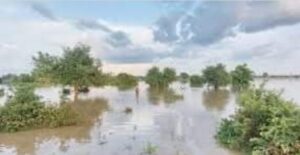
While some communities are experiencing longer dry periods and declining annual rainfall, the rains that eventually arrive can be intense, creating flooding, erosion and damage to farms and infrastructure.
The assessment cited an average eight per cent decline in annual rainfall in the affected areas, alongside declining surface-water availability and groundwater recharge.
The Water Resources Commission’s Head of the White Volta Basin, Jesse Kazapoe also warned that rainfall is becoming increasingly erratic, with heavier rainfall occurring over shorter periods.
Such events can cause flooding, soil erosion and sedimentation of dams and other water bodies.
For farmers, the consequences can be severe.
Too little rainfall can result in crop failure, depleted pasture and livestock stress, while excessive rainfall at the wrong time can wash away crops, erode farmland and damage infrastructure.
The uncertainty makes it increasingly difficult for farmers to determine when to plant, what crops to cultivate and whether their investment will survive the farming season.
When the WASH crisis becomes a livelihood crisis
The climate crisis also has a direct WASH dimension.
When reliable sources of safe water become scarce, women and children often bear a disproportionate burden of water collection.
Families may also be compelled to depend on unsafe water sources, increasing their vulnerability to water-related diseases.
But the consequences extend beyond health.
Every additional hour spent searching for water can mean less time available for farming, petty trading, education and other productive activities.
This makes water scarcity both a WASH problem and a livelihood problem.
The journalists are therefore being encouraged to connect WASH reporting with agriculture, gender, education, health, migration, poverty and food security.
Beyond reporting disasters
The training also challenged journalists to move from simply reporting climate disasters to scrutinising climate adaptation and resilience measures.
Journalists are expected to investigate whether climate-resilience projects are reaching the communities most affected, whether resources allocated for adaptation are being effectively utilised and whether district development plans are adequately responding to changing climate conditions.
One intervention is WaterAid Ghana’s Securing Water Access Project (SWAP), which targets the same five districts and seeks to strengthen community water-resource management and climate-resilient WASH services.
The initiative also focuses on generating community-level rainfall and groundwater data and promoting the integration of WASH into climate adaptation planning.
For the journalists, these interventions provide opportunities to go beyond launch stories and follow the projects to determine whether they are delivering measurable improvements for communities.
A new reporting agenda
The journalists’ emerging mandate is therefore not simply to report when drought strikes, floods occur or water systems fail.
It is to follow the climate crisis into the farms, kraals, homes, markets, schools and water points where its consequences are being experienced every day.
They are expected to give a voice to farmers who lose crops, livestock owners struggling to find pasture and water, women spending hours searching for water, businesses disrupted by extreme weather and families whose traditional livelihoods are becoming increasingly difficult to sustain.
With 30 WASH journalists trained and equipped with practical approaches to identify, develop and frame climate stories, the expectation is that northern Ghana’s climate vulnerability will receive more sustained and people-centred media attention.
The ultimate goal is to ensure that climate change is no longer reported only as a distant environmental phenomenon, but as an unfolding crisis affecting water, food, livestock, livelihoods, health and the economic survival of communities across northern Ghana.