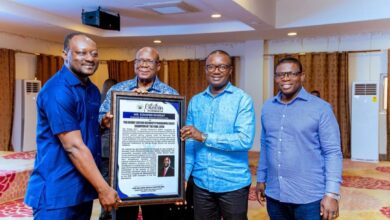

Ensign Global University Challenges 65 Graduates to Lead Fight Against Galamsey


|
Getting your Trinity Audio player ready...
|
By: Samuel Asamoah
Ensign Global University has challenged 65 newly graduated public health professionals to intensify advocacy against illegal mining and its devastating effects on public health, particularly the contamination of water sources.
The call was made at the university’s 11th Congregation in Kpong in the Eastern Region, where 65 students were awarded Master of Public Health (MPH) degrees as part of the Class of 2026.
Delivering the keynote address, the Konor of Manya Krobo and President of the Eastern Regional House of Chiefs, Nene Sakitey II, warned that illegal mining was exposing communities in the Eastern Region to serious public health risks, with some residents already consuming contaminated water.

“Today, as we gather here, some communities in my region in the Eastern Region are drinking contaminated water. This is by far a human calamity, to say the least,” he said.
He urged the graduates to recognise that public health extends beyond treating diseases to addressing the social and environmental conditions that determine people’s wellbeing, including access to clean water, decent housing and justice.
Nene Sakitey II said the greatest achievement of public health professionals often lies in preventing crises before they occur, even when their contributions attract little public recognition.
He encouraged them to remain committed to prevention, describing it as a quiet revolution that requires determination, humility and sustained advocacy.
Renowned pathologist and board member of the university, Professor Agyemang Badu Akosa, also challenged the graduates to sustain advocacy against galamsey, describing its health consequences as a public health emergency requiring urgent attention.
Guest Speaker and Executive Vice President for Health Sciences and Chief Executive Officer of the University of Utah, Dr Bob Carter, commended Ensign Global University for strengthening health education in Africa.
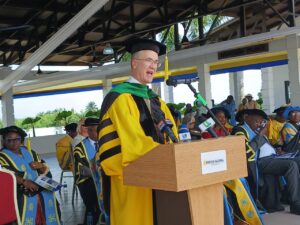
He highlighted the longstanding partnership between the two institutions, noting that it was anchored in a shared commitment to improving human wellbeing.
Dr Carter described the graduates as a unique group who had returned to academic work while already holding professional responsibilities, urging them to uphold the university’s three pillars of Leadership, Professionalism and Entrepreneurialism.
He stressed that effective leadership required staying present during difficult times, listening to those being led and helping teams remain focused on progress despite resource constraints.
On professionalism, he emphasised the importance of trust, integrity and maintaining high standards, even when no one was watching.
Dr Carter also urged the graduates to pay attention to complex social challenges such as human trafficking, stressing the need for public health interventions to reach vulnerable people who might never access conventional healthcare services.
President of Ensign Global University, Professor Stephen Alder, said the institution was working with communities to address environmental threats with serious public health implications.
He reaffirmed the university’s commitment to advancing public health education and producing professionals capable of leading preventive healthcare interventions across Africa.
The ceremony brought together academics, traditional leaders, faculty members from the University of Utah, families and members of the university’s governing board.
The 65 graduates join the university’s growing alumni network of public health professionals working across Ghana and beyond.