
|
Getting your Trinity Audio player ready...
|
- By Mercy Hededzome
The Wassa Professionals Network (WPN) has called on the government to secure a 10 per cent free-carried equity stake for host communities in the Tarkwa Gold Fields mine as part of negotiations for the renewal of its mining lease, expected to expire in April 2027.
The Network is also demanding a two per cent allocation of gross mineral sales revenue to a proposed Wassa Trust Fund, alongside formal representation of host communities in mining lease negotiations and the governance structures of future mining operations in the area.
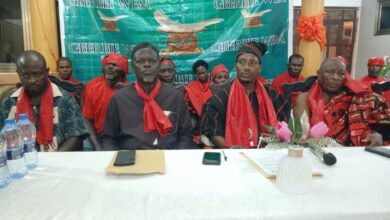
President of the Network, Mr Justice Joshua Cobbina, made the demands at a media briefing in Accra on the proposed lease renewal, describing it as an opportunity to address what he considers an imbalance in the distribution of mining wealth between investors, government and host communities.
He argued that communities which provide the land and bear the environmental and social consequences of mining should have a direct ownership interest in the resources extracted from their ancestral lands.
According to him, employment opportunities, local procurement, compensation and corporate social responsibility programmes cannot adequately replace direct equity participation in mining operations.
“National ownership should not mean community exclusion,” he stressed.
Mr Cobbina proposed that the 10 per cent community equity interest be held through an accountable Wassa Trust Fund, with voting rights and representation on the boards of mining companies.
He said the additional two per cent of gross mineral sales revenue should be paid quarterly into the fund without deductions for operating costs, debts or management fees.
He emphasised that the proposed arrangements would be additional to statutory royalties, taxes, compensation, environmental restoration obligations and existing community development commitments.
To support the demands, Mr Cobbina cited research indicating that approximately 4,935 hectares of farmland were lost between 1986 and 2002 across the Tarkwa, Bogoso-Prestea and Damang mining concessions, representing about 45 per cent of farmland in the areas studied.
He also referred to research which estimated a 40 per cent relative reduction in agricultural productivity near Ghanaian gold mines between 1997 and 2005.
Although the studies covered historical periods, he said they illustrated the long-term implications of mining for agriculture, livelihoods and community development.
He further cited community displacement, environmental degradation, loss of ancestral graves and sacred sites, and human rights concerns as some of the challenges experienced in mining communities.
“The people of Wassa deserve more than compensation for what they lose. They deserve an enduring stake in the wealth their lands produce,” he said.
On the economic prospects of the Tarkwa mine, Mr Cobbina referenced Gold Fields’ November 2025 mineral resources and reserves declaration, which showed managed mineral reserves increasing from 4.23 million ounces in 2024 to 7.4 million ounces in 2025.
He said the declaration indicated an estimated mine life of approximately 17 years, with further potential from additional mineral resources, underground development and exploration.
He also cited reported 2025 contributions of approximately GH¢5.8 billion in corporate taxes, royalties and dividends to government, as well as GH¢8.8 billion in local procurement.
While acknowledging Gold Fields Ghana Limited’s contributions to the national economy, he argued that the scale of the mine’s operations justified a review of how host communities participate in its ownership and economic benefits.
Under Ghana’s existing mining ownership framework, government holds a 10 per cent free-carried interest in mining operations, while host communities have no equivalent automatic entitlement.
The WPN is therefore proposing a revised ownership structure under which mining investors would hold 60 per cent, government 10 per cent, host communities through the proposed Wassa Trust Fund 10 per cent, and the remaining 20 per cent would be floated on the Ghana Stock Exchange.
Mr Cobbina acknowledged that the proposal would require legal, regulatory and commercial considerations but maintained that community participation should become a central component of future mining arrangements.
He cited examples from South Africa, Botswana, Tanzania, Guinea, Papua New Guinea, Canada and Australia, where different models have been introduced to strengthen local participation and community benefits from mineral extraction.
He said the approaching expiry of the Tarkwa mine lease provided an appropriate opportunity to revisit existing arrangements, noting that legally binding agreements between governments and mining companies could limit the scope for fundamental changes before their expiration.
He also raised concerns about the long-term effects of surface and underground mining, including the loss of agricultural land and abandoned mining pits in communities such as Tarkwa Bay and Bogoso.
Drawing on his research in the Tarkwa Bay area, he said peasant farmers constituted less than 20 per cent of the population, a situation he attributed largely to the loss of agricultural land to mining activities.
Mr Cobbina argued that land provided by host communities should be recognised as an equity contribution in mining arrangements rather than merely treated as a natural resource available for exploitation.
He maintained that the proposed equity arrangement was a business proposition aimed at securing a more equitable partnership between investors and indigenous communities, rather than a demand for charity.
The Network also wants host communities to develop the technical and institutional capacity to participate directly in mining activities when they acquire the necessary expertise and technology.
The Wassa Professionals Network, which brings together professionals in agriculture, medicine, mining, engineering, law, banking and commerce, said it was prepared to engage the government, Parliament, the Minerals Commission, Gold Fields Ghana Limited, traditional authorities and other stakeholders on the proposals.
Mr Cobbina stressed that the Network was not opposed to mining investment but wanted future arrangements to guarantee lasting economic benefits for communities whose lands sustain the industry.
He said the renewal of the Tarkwa mine lease should go beyond extending mineral extraction and create an opportunity for community ownership, responsible mining and shared prosperity in Wassa.