
|
Getting your Trinity Audio player ready...
|
By: Samuel Asamoah
The Inter-Governmental Action Group against Money Laundering in West Africa (GIABA) has urged journalists across the sub-region to strengthen their investigative skills and follow financial trails to expose economic and financial crimes.
GIABA says the changing nature of financial crime, driven by technology, digital financial services, virtual assets, complex corporate structures and cross-border transactions, requires journalists to develop stronger capacity to uncover the people and networks behind illicit financial activities.
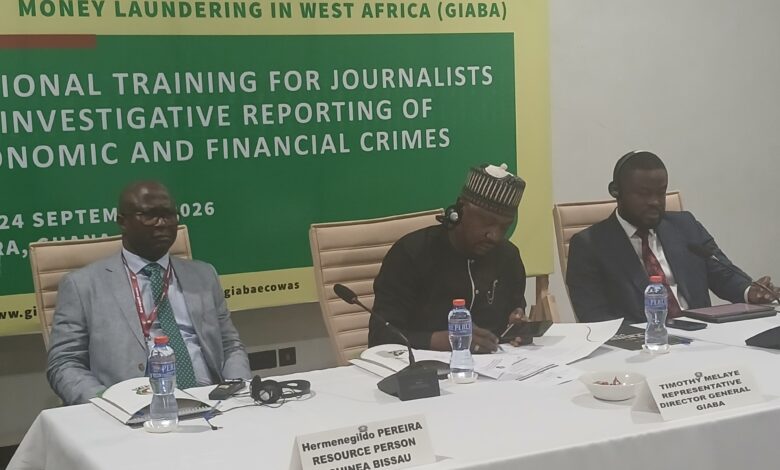
The call was made at the opening of a three-day Regional Training Workshop on Investigative Journalism on Economic and Financial Crimes, being held in Accra from September 22 to 24, 2026.
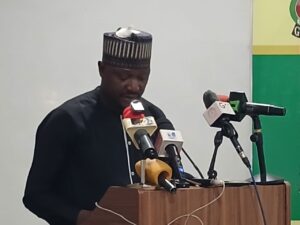
In an address delivered on his behalf, GIABA Director General, Mam Cherno Jallow, said high-level corruption, illicit financial flows from the extractive sector, terrorism-related activities, drug trafficking, misuse of virtual assets and weak regulatory oversight of designated non-financial businesses and professions remain significant vulnerabilities in West Africa.
He said journalists have a critical role to play in exposing such activities and strengthening transparency and accountability.
“Your role in keeping watch, raising awareness and investigation places you at the heart of our push for transparency and accountability,” he said.
According to him, investigative journalism can help uncover illegal practices, alert the public, challenge decision-makers and strengthen governance.
Mr Jallow said GIABA had, since 2009, deliberately engaged journalists across ECOWAS member states as part of efforts to strengthen reporting on money laundering and terrorist financing.
He noted that GIABA’s media engagement had attracted international attention, with other Financial Sector Regional Bodies learning from its approach to working with journalists.
He said the training was therefore intended to sharpen journalists’ skills in reporting economic and financial crimes, strengthen collaboration between GIABA and the media, expose journalists to regional anti-money laundering and counter-terrorist financing initiatives, and equip them with modern investigative techniques.
FIC calls for evidence-based reporting
In a separate welcome address delivered on behalf of the CEO of the Financial Intelligence Centre (FIC), Albert Kwadwo Twum Boafo, participants were urged to look beyond transactions and investigate the ownership, movement and ultimate destination of assets.
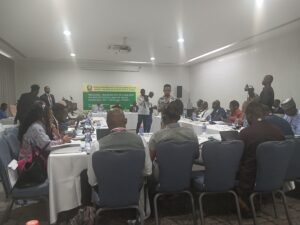
The address, delivered on behalf of the FIC CEO, said no single institution could effectively combat economic and financial crime without collaboration among financial intelligence units, law enforcement agencies, regulators, prosecutors, the judiciary, the private sector, civil society and the media.
The FIC said the increasing sophistication of financial crimes demands that journalists understand corporate structures, examine financial records, identify beneficial owners, analyse procurement information, connect seemingly unrelated transactions and use open-source intelligence.
“The modern financial crime reporter must be able to follow the money,” the address said.
It further cautioned journalists that investigative reporting should not end with obtaining information, but must involve verification, contextual understanding, source protection and adherence to professional standards.
The FIC said financial intelligence could reveal patterns that individual transactions might not disclose, including networks concealed behind apparently unrelated transactions and companies that appear legitimate but have complicated ownership structures.
Journalists, it said, have a responsibility to connect such information, investigate matters of public interest and explain complex financial issues in language that ordinary citizens can understand.
The Centre urged journalists to focus on producing evidence-based and impactful journalism rather than simply increasing the volume of reports on financial crime.
GIABA highlights progress
GIABA also outlined progress made under its 2023–2027 Strategic Plan, which is aligned with the ECOWAS Vision 2050.
The organisation said it had supported member states in strengthening legal and institutional frameworks to bring them in line with Financial Action Task Force standards, while Financial Intelligence Units had been established in almost all member states.
It also cited capacity-building programmes for magistrates, judges, lawyers, investigators, customs officers, bankers, insurers, regulators, civil society organisations, religious leaders, youth and women’s groups.
GIABA said it had also championed beneficial ownership disclosure and encouraged countries to establish public registers of ultimate beneficial owners of companies to reduce opportunities for criminals to conceal ownership.
The organisation further said it had completed the first and second rounds of mutual evaluations of its member states and had commenced the preliminary component of the third round.
Warning over poor reporting
Mr Jallow, however, expressed concern about what he described as poor reporting of anti-money laundering and counter-terrorist financing issues, inadequate due diligence and instances of misinformation among journalists.
He urged participants to use the training to deepen their understanding of financial crime and establish stronger professional partnerships.
The FIC similarly encouraged journalists to use the three-day programme to question assumptions, share experiences and build professional relationships that could continue beyond the workshop.
It urged participants to look beyond the workshop and investigate “the story behind the transaction, the person behind the company, the ownership behind the asset and the financial trail behind the crime.”
The regional training brings together journalists and experts as part of continuing efforts to strengthen investigative reporting and public awareness of money laundering, terrorist financing and other economic and financial crimes in West Africa.
GIABA said its broader objective was to contribute to a West African region that is more resilient to money laundering, terrorist financing and other forms of financial crime.