
|
Getting your Trinity Audio player ready...
|
The Panama Canal Authority has announced fresh restrictions on vessel traffic as worsening drought conditions continue to reduce water levels in the canal’s watershed.
Daily ship transits will be reduced to 34 from September 4, down from the previous limit of 36, before falling further to 32 from September 15.
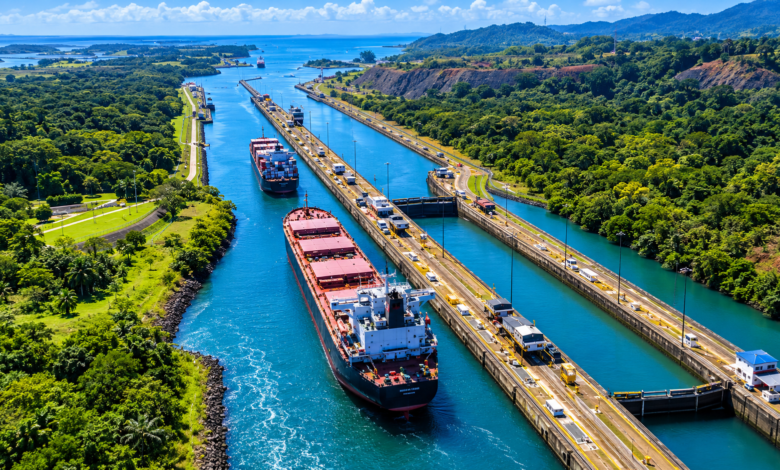
Under the new measures, the Neopanamax locks will accommodate a maximum of nine vessels a day, while the older Panamax locks will handle 25 vessels from September 4. That figure will drop to 23 from September 15.
The Panama Canal Authority (ACP) said the decision had become necessary because rainfall in the canal watershed has been significantly lower than anticipated. Between May and August, rainfall in the canal zone was 34 per cent below the historical average.
The move represents a reversal of the Authority’s position in May, when it indicated that further traffic restrictions would not be necessary this year.
The Panama Canal relies heavily on rainfall to maintain water levels in the artificial Gatun and Alajuela lakes, which provide the water required for the operation of its locks. Each vessel passing through the canal uses approximately 200 million litres of fresh water.
Ilya Espino de Marotta, who assumed the position of Administrator of the Panama Canal Authority on Monday, said additional restrictions could become necessary if the dry conditions persist.
She said the rainfall recorded during September, October and November would be critical in determining whether further reductions would be introduced early next year.
“If the drought continues, we cannot rule out the possibility of reducing the number of daily transits in February or March,” Espino said, adding that the reduction could be to around 29 vessels per day rather than the 24-vessel level seen during the worst period of the previous drought.
The Authority does not, however, expect the current situation to deteriorate to the levels recorded during the severe 2023-24 drought, when daily crossings were reduced to as few as 22 vessels.
The latest restrictions come at a time when demand for the canal is increasing. Shipping companies have increasingly sought alternative routes because of security concerns around the Strait of Hormuz amid tensions involving the United States, Israel and Iran.
Canal traffic averaged about 35 vessels a day through June, with some days recording between 40 and 41 transits, exceeding the waterway’s nominal capacity of 40 vessels.
The Panama government has declared a nationwide emergency over the effects of El Niño, a Pacific Ocean warming phenomenon that can trigger significant changes in weather patterns and contribute to higher temperatures.
In response to the worsening water shortage, the Canal Authority has introduced several conservation measures. These include imposing draft restrictions on the largest vessels, making greater use of water-saving basins at the Neopanamax locks and reducing hydroelectric power generation at the Gatun facility.
The Authority also operates a reservation system for vessels seeking to transit the canal. Most ships normally secure reservations in advance, while the remaining available slots are allocated through an auction system.
With rainfall expected to remain the key factor in determining future restrictions, the coming months will be closely watched by shipping companies and global traders that depend on the Panama Canal as a major link between the Atlantic and Pacific oceans.