
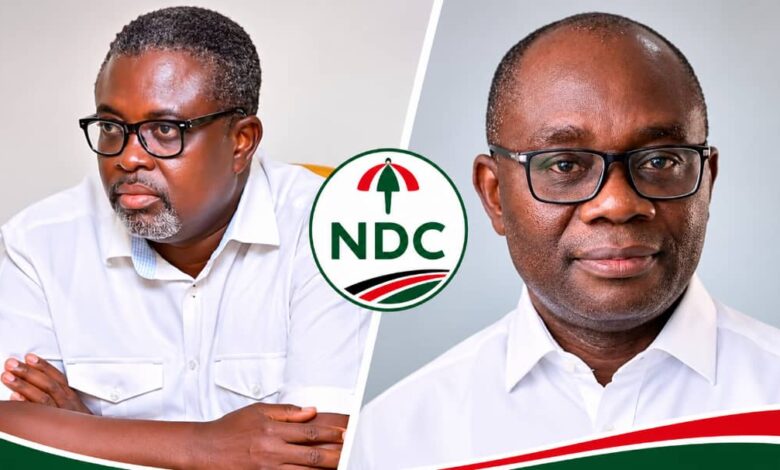
Breaking: Former NDC Central Regional Chairman Takes Party, EC On Over Alleged Voter Fraud in 8-Votes Defeat

|
Getting your Trinity Audio player ready...
|
By Edward Graham Sebbie
The just-ended National Democratic Congress, NDC, Central Regional chairmanship election heads to court as Former Central Regional Chairman, Richard Kofi Asiedu, has filed a writ at the Accra High Court challenging the election of Obeng Inkoom as the new Central Regional Chairman.
He alleges voter fraud, unlawful participation and breach of the party’s constitution in the suit number GJ/0174/2027, filed on 20th November 2026, listing the NDC, Obeng Inkoom, and the Electoral Commission of Ghana as 1st, 2nd and 3rd defendants respectively.
The 8-Vote Margin That Triggered The Suit
According to the statement of claim filed by his lawyer, Martin L. Kpebu of Black Star Legal Services, Asiedu lost the election held on 14th November 2026 by just eight votes.
Figures reported to him were:
– Richard Kofi Asiedu – 364 votes
– Obeng Inkoom – 372 votes
– Ibrahim Mohamed – 16 votes
Asiedu contends that the 8-vote margin was as a direct result of unlawful admission of persons who were not qualified delegates.
The Nine Handwritten Names
Central to the case is what the plaintiff describes as a doctored register.
He alleges that the Cohort 4 register, headed “Regional Executives and Special Voters”, bore a printed total of 137 but had handwritten alterations. Nine handwritten names, some later crossed out, were allegedly introduced after the final album was closed.
The nine persons named in the suit are:
Yalley Sebastian, Stephen Edward Mork, Ransford Amoah, Salifu Mohammed, Nanewotor Daniel, Hawa Ahmed, Jannet Manerh, Owusu Koby Acheampong and Charles Quansah.
Asiedu claims these persons were admitted to vote at Cohort 4 contrary to article 18(5) of the NDC constitution and Section F, Paragraph 2.0 of the 2026 election guidelines, which prescribe who qualifies as a delegate.
He further alleges that at Cohort 4, his accredited polling agent observed an officer of the Electoral Commission entering names in red ink on a separate sheet outside the cohort register and using that sheet to admit persons to vote.
“No Supplementary Register” Directive Breached
The plaintiff relies on a notice issued before the election by the NDC Director of Elections, titled “Notice to All Appointees”, which required appointees whose names were missing to submit particulars by 2nd November 2026 and expressly stated there would be “NO SUPPLEMENTARY REGISTER”.
Asiedu argues that the handwritten entries and the separate red-ink sheet constituted an unauthorized supplementary register, in breach of that directive.
He also cites another anomaly in Cohort 1 register, headed “Polling Station 1 Constituencies”, where a printed total of 223 was allegedly altered by hand to 224, with a handwritten entry for one Mohammed Ibrahim described as Zongo Caucus Coordinator.
Recount Denied
The suit further claims that when his representatives raised concerns about reconciliation of figures at Cohort 2 and requested a recount in accordance with electoral rules, the presiding officer declined, and his agent refused to sign the results.
Immediately after the disputed declaration, Obeng Inkoom was sworn in as Central Regional Chairman.
Reliefs Sought
Asiedu is asking the High Court to:
– Declare the 14th November 2026 Central Regional chairmanship election invalid for violating article 55(5) of the 1992 Constitution, sections 17(1) and (2) of the Political Parties Act, Act 574, and the NDC’s own guidelines;
– Set aside the election and the declaration of Obeng Inkoom as chairman;
– Order the NDC, under EC supervision, to conduct a fresh election;
– Place perpetual injunction restraining the NDC from recognizing Obeng Inkoom and restraining him from holding himself out as Central Regional Chairman;
– Order preservation and production of all original electoral materials;
– And costs.
He states that he had earlier petitioned the Functional Executive Committee (FEC) of the NDC on 16th November 2026 but the party has neither acknowledged receipt nor taken steps to address his grievances, forcing him to resort to court.
The writ, signed by Chief Justice P. Baffoe-Bonnie, commands the defendants to cause an appearance to be entered within eight days of service, failing which judgment may be given in their absence.