
24-HOUR ECONOMY AUTHORITY TO ESTABLISH PHARMACEUTICAL PARK AT OSUDOKU
Project expected to cut Ghana’s 70% dependence on imported medicines and create up to 20,000 jobs

|
Getting your Trinity Audio player ready...
|
By: Samuel Asamoah
The 24-Hour Economy and Accelerated Export Development Authority has announced plans to establish a major pharmaceutical and medical devices park in the Osudoku District of the Greater Accra Region as part of efforts to reduce Ghana’s dependence on imported medicines.
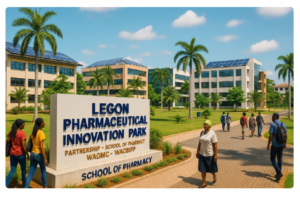
The proposed Legon Pharmaceutical Innovation Park is expected to provide an integrated ecosystem for pharmaceutical manufacturing, medical device production, research and development, herbal medicine and the production of key pharmaceutical inputs.
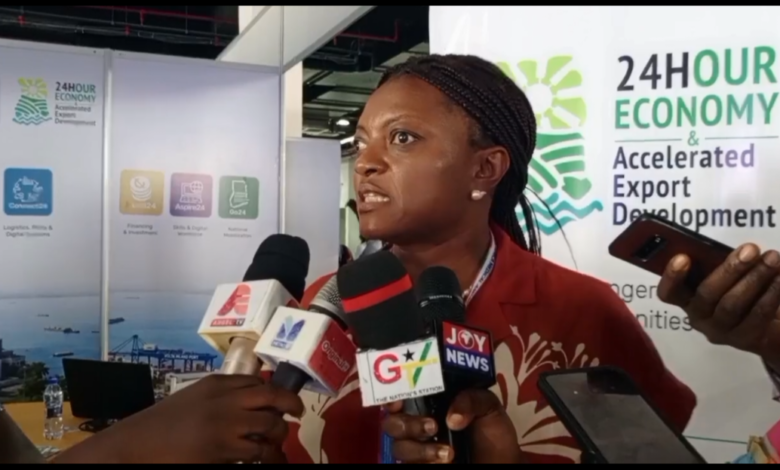
The Authority’s Project Development official, Kafui Abotsi, disclosed the plans at the Authority’s exhibition stand, where she said Ghana currently imports about 70 per cent of its pharmaceutical needs, including finished medicines, test kits, active pharmaceutical ingredients and other manufacturing inputs.
She described the situation as unsustainable and said the proposed park would help build Ghana’s capacity to produce essential medicines and medical products locally.
«“We don’t produce devices, so we import HIV test kits and malaria test kits and all of that. The park will do that in addition to producing pharmaceutical products. We are looking at a park that will also host herbals and also research and development,” she said.»
Osudoku site secured
According to Ms. Abotsi, a site has already been secured in the Osudoku District, with pre-feasibility studies completed.
She said the project had an anchor investor who would partner the government to develop the park, while a pipeline of prospective tenants was also being developed.
The potential investors include existing Ghanaian pharmaceutical manufacturers, international companies from India, China and the United States, as well as Ghanaian health professionals in the diaspora.
Ms. Abotsi said the Authority had also drawn lessons from India’s largest pharmaceutical park following a recent visit, with some companies associated with the facility subsequently expressing interest in the Ghanaian project.
20,000 jobs projected
The proposed facility is expected to go beyond a conventional industrial park, with plans for an integrated township that will include housing facilities for workers.
The Authority projects that the development could create up to 20,000 jobs within its first five years.
The park is also expected to provide shared infrastructure to address some of the major challenges facing pharmaceutical manufacturers, particularly access to land and reliable industrial utilities.
These will include roads, water supply, electricity, wastewater treatment and specialised effluent treatment facilities.
“For pharma, effluent treatment is a big part of it. So the park will provide all this bulk infrastructure facility,” Ms. Abotsi explained.
Focus on entire pharmaceutical value chain
The Authority says the park will not only manufacture finished medicines but also target the production of Active Pharmaceutical Ingredients (APIs) and excipients used in medicine production.
Ms. Abotsi said Ghana currently imports these critical inputs, including materials such as starch and alcohol, in addition to importing finished pharmaceutical products.
She said the objective was to establish capacity across the entire value chain so Ghana could become more self-sufficient in medicines and better prepared for future health emergencies.
«“The goal is to ensure that we build a park that will cater for the whole value chain so that when we are confronted by a pandemic like COVID in the future we will be self-sufficient like countries like India,” she said.»
The initiative is also expected to support the production of medicines needed to address Ghana’s changing disease burden, including drugs for non-communicable diseases such as stroke and diabetes.
Landowners to become shareholders
To address potential challenges associated with land acquisition, the Authority says it is adopting a participatory model under which host communities and landowners could become shareholders in the project.
Ms. Abotsi explained that, in addition to receiving rental income from their land, participating landowners would receive dividends as shareholders.
«“What we are doing is to encourage the community and the land owners to be shareholders in the park so aside paying them their rental income they will be shareholders so every year they get some dividends,” she said.»
The Authority believes the arrangement will give host communities a direct economic stake in the development.
Project development to be completed this year
Ms. Abotsi said all major project development activities, including the full feasibility study, master planning and design, are expected to be completed by the end of the year.
The Authority is also expected to work closely with the Pharmaceutical Manufacturers Association of Ghana, whose members have already begun expanding their manufacturing operations.
The proposed pharmaceutical park forms part of the broader 24-Hour Economy strategy to expand domestic production, attract investment, create jobs and reduce Ghana’s import dependence.
If successfully implemented, the Osudoku project could position Ghana as a major pharmaceutical manufacturing centre in the West African sub-region while strengthening the country’s capacity to produce medicines and critical health products locally.