
Drowning in Progress: Ghana’s 2026 Floods Expose a Broken City
As torrential rains continue to devastate communities across Ghana, a troubling reality is becoming impossible to ignore: the country's perennial flooding crisis is no longer simply a natural disaster—it is a man-made tragedy fueled by poor planning, weak enforcement, environmental degradation and climate change.

|
Getting your Trinity Audio player ready...
|
By John Justice Ahoto
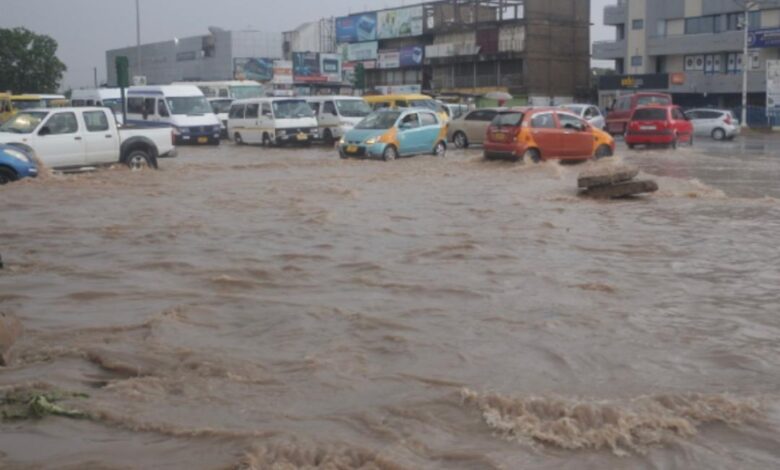
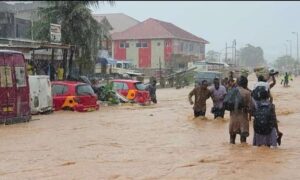
When heavy rains pounded Accra on June 3, 2026, it took only a matter of minutes for some of the capital’s busiest commercial and residential areas to disappear beneath muddy floodwaters. Communities including Kaneshie, Odawna, Adabraka, Circle and Doblo Gonno New Site were inundated as overflowing drains and rivers reclaimed spaces that nature had long intended to remain waterways.
The Ghana National Fire Service rescued at least 21 people trapped by rapidly rising floodwaters. Thousands of commuters were stranded, businesses suspended operations, and residents watched helplessly as floodwaters swept away years of investment.
For many Ghanaians, however, the disaster felt painfully familiar.
“This is the same story every rainy season,” lamented one resident while attempting to salvage belongings from his flooded home. That sentiment has become an annual refrain in a country where floods have gradually shifted from isolated emergencies to predictable national events.
A Disaster Foretold
Unlike previous decades when floods often caught authorities by surprise, Ghana entered the 2026 rainy season with clear scientific warnings.
The Ghana Meteorological Agency (GMet) projected that Greater Accra and Tema could receive between 100 and 150 millimetres of rainfall during major weather events, while parts of the Forest Zone, including Kumasi, were expected to record between 200 and 400 millimetres.
More significantly, meteorologists warned that Accra’s drainage systems had become so compromised that as little as 30 millimetres of rainfall could now trigger severe flooding in several communities.
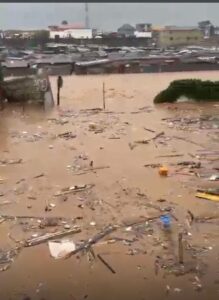
Years of encroachment on wetlands, blocked drains and uncontrolled urban expansion have drastically reduced the city’s natural ability to absorb stormwater.
The forecast was not merely a weather update—it was a call to action.
Unfortunately, much of that action never materialised.
A Growing Humanitarian Crisis
The destruction has spread well beyond Accra.
In the Central Region alone, authorities recorded more than 1,170 flood-related incidents within just four days during the early part of the rainy season. At least 138 houses collapsed, two schools suffered extensive damage and over 1,100 residents were displaced. The Cape Coast Metropolis accounted for the destruction of 66 homes.
Across the country, thousands of traders lost merchandise as floodwaters invaded markets, while families watched household possessions disappear beneath muddy currents.
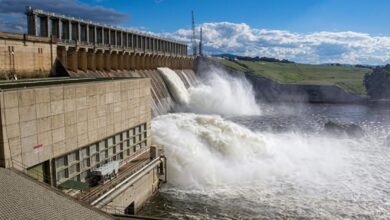
Following controlled spillage from the Akosombo and Kpong dams, the National Disaster Management Organisation (NADMO) relocated approximately 26,000 residents from vulnerable communities to safer locations.
The agricultural sector has not been spared either. Cocoa farmers are reporting heavy losses as persistent rains have accelerated outbreaks of black pod disease while damaging flowering cocoa trees, threatening future harvests and export earnings.
Behind every statistic lies a personal tragedy—a child unable to attend school, a trader whose life’s savings vanished overnight, or a family forced to start over after losing everything.
Counting the Economic Cost
Flooding is no longer only a humanitarian issue; it has become a major economic threat.
Studies by the World Bank estimate that property worth approximately US$3.2 billion in Accra currently lies within flood-prone areas. Without significant intervention, climate projections suggest that exposure to flood risk could increase dramatically by mid-century as rainfall intensity rises and urbanisation accelerates.
Each flood event destroys roads, bridges, businesses, homes and public infrastructure, diverting billions of cedis that could otherwise support education, healthcare and economic development.
The recurring losses continue to undermine investor confidence while placing enormous pressure on government resources.
Why Does Ghana Keep Flooding?
While climate change has increased rainfall intensity, experts argue that nature alone cannot be blamed.
For decades, physical planning authorities have approved developments within waterways and wetlands that historically served as natural flood retention areas. Rivers have been narrowed, marshlands filled with concrete, and drainage channels obstructed by illegal structures.
Plastic waste has compounded the crisis, choking drains and preventing stormwater from flowing freely into rivers and the sea.
Environmental degradation upstream has worsened matters. Illegal mining activities have heavily silted major rivers, reducing their capacity to carry water and increasing overflow during heavy rains.
The Director-General of the Ghana Meteorological Agency captured the frustration succinctly when she remarked that meteorologists provide accurate forecasts, but implementation rests with institutions responsible for planning, drainage maintenance and law enforcement.
In other words, technology can predict disasters, but it cannot prevent them.
Lessons From Cities That Chose a Different Path
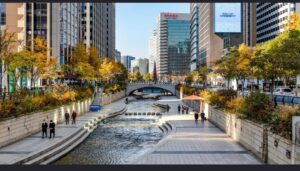
Around the world, cities facing similar challenges have transformed flooding from a recurring disaster into a manageable risk.
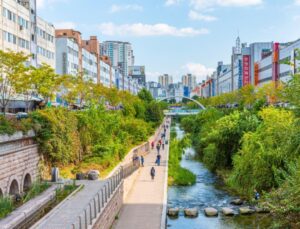
Seoul removed a major highway to restore the historic Cheonggyecheon stream, creating a flood-control corridor that doubles as a public recreational space.
Rotterdam introduced innovative “water squares” that function as parks during dry weather but temporarily store stormwater during heavy rainfall.
Tokyo invested in one of the world’s largest underground stormwater diversion systems, capable of protecting millions of residents from severe flooding.
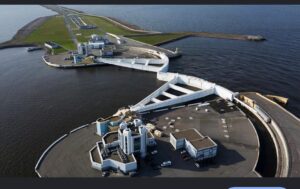
Saint Petersburg constructed a sophisticated flood barrier system that has significantly reduced damage from storm surges.
These examples demonstrate that flooding need not remain an unavoidable annual disaster. With political commitment, sound engineering and long-term planning, cities can coexist safely with water.
Building a Flood-Resilient Ghana
Ghana has begun taking small but encouraging steps.
Authorities in Cape Coast have initiated efforts to identify structures built within waterways for possible removal. Similar exercises are expected elsewhere.
Yet experts believe far more comprehensive action is required.
Wetlands around the Odaw and Korle basins must be restored to their ecological functions. Drainage infrastructure should be expanded and modernised. Urban developments should incorporate permeable pavements, green roofs, underground stormwater storage systems and smart drainage monitoring technologies.
Equally important is enforcing building regulations without political interference while strengthening waste management systems to prevent drains from becoming clogged.
Climate adaptation financing will also be essential as extreme weather events become more frequent.
Beyond Infrastructure
Engineering solutions alone cannot solve Ghana’s flooding crisis.
Public attitudes toward waste disposal, illegal construction and environmental protection must change.
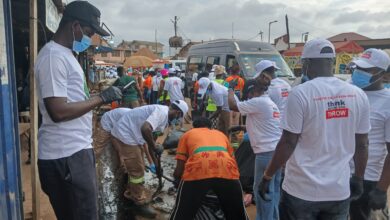
Routine desilting of drains should become preventive rather than reactive. Communities must stop treating waterways as dumping sites. Local authorities must enforce sanitation laws consistently rather than only after disasters strike.
Flood resilience ultimately depends on collective responsibility involving government, businesses and citizens alike.
The Choice Before Ghana
Rainfall will continue to intensify as climate change reshapes weather patterns across West Africa. That reality cannot be altered.
What can change is how Ghana prepares for it.
Every flood that destroys homes, businesses and livelihoods raises the same uncomfortable question: will the nation continue rebuilding in flood-prone areas, or finally begin building cities designed to live with water rather than fight against it?
The Ghana Meteorological Agency will continue issuing forecasts. Emergency responders will continue rescuing victims.
But until planning authorities protect wetlands, engineers modernise drainage systems, and citizens respect the environment, the country’s rainy season will remain synonymous with loss.
The headline has become painfully familiar.
Whether it continues to define Ghana’s future is a decision that rests not with the weather, but with the nation itself.