
Ghana Turns to Circular Economy to Tackle Sanitation Crisis as Government Woos Private Investors

|
Getting your Trinity Audio player ready...
|
By Samuel Asamoah
Ghana is stepping up efforts to address its sanitation crisis through private sector investment, innovative waste management systems and circular economy solutions, as government seeks to transform human and organic waste into valuable economic resources.
The initiative is expected to expand access to decent household toilet facilities, improve waste treatment, generate renewable energy and create employment while addressing the persistent practice of open defecation across the country.
The renewed commitment was highlighted at a pre-World Toilet Day 2026 commemoration at the Safisana waste treatment facility in Ashaiman, where government officials, development partners, diplomatic representatives and private sector operators called for stronger investment in the sanitation value chain.
The event was held under the national theme, “From Open Defecation to Open Opportunity Through the Gender Lens.”
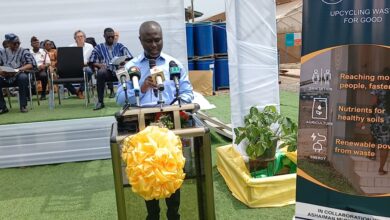
Speaking on behalf of the Deputy Minister of Local Government, Chieftaincy and Religious Affairs, the Ministry’s Technical Advisor for Sanitation and WASH, Mr Michael Forson, said government was committed to creating an enabling environment for private sector participation in sustainable sanitation management.
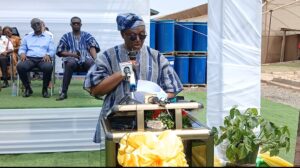
He said the Ministry would work with development partners and private investors to expand waste-to-energy and waste-to-fertilizer initiatives, while aligning relevant policies with national development priorities.
Mr Forson said government would also strengthen regulatory support, facilitate access to land for waste treatment infrastructure and improve collaboration among ministries, local authorities and development partners to accelerate sanitation investments.
He stressed that tackling open defecation required collective responsibility, particularly from households, traditional authorities, religious organisations and private sector operators.
According to figures presented at the event, approximately 5.4 million Ghanaians still practise open defecation, while about 8,500 public basic schools lack toilet facilities.
Poor sanitation is estimated to cost the country US$290 million annually, with women and girls bearing a disproportionate share of its health, safety and educational consequences.
“When sanitation fails, women and girls pay first and pay most. When it works, they gain safety, dignity, and time to learn, to earn, and to lead,” the Deputy Minister said in her statement read by Mr Forson.
The Deputy Minister also highlighted government’s engagement with Traditional Councils, Houses of Chiefs, Christian and Muslim leaders to promote household toilet construction and improve hygiene education.
Private Sector Investment Critical
The Ashaiman Municipal Chief Executive, Mr Freeman Tsekpo, called on private investors and business operators to partner local authorities in developing affordable household toilet facilities and sustainable waste management solutions.
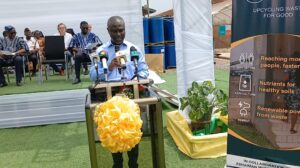
He said the continued practice of open defecation, despite investments in public toilet facilities, demonstrated the need for innovative household sanitation solutions that residents could afford.
Mr Tsekpo said the Ashaiman Municipal Assembly was pursuing improved waste management through segregation and recycling but required stronger private sector participation to achieve sustainable results.
He urged investors to explore business opportunities in affordable household toilets, waste collection, recycling and treatment infrastructure.
The MCE’s appeal reflects growing concerns that sanitation challenges cannot be resolved through public infrastructure investments alone without sustainable financing and active private sector participation.
Earlier, the WASH Technical Advisor, Ing. Michael Forson, commissioned 10 boreholes constructed by the Ashaiman Municipal Assembly for selected schools in the municipality.
The intervention is expected to improve access to safe water and strengthen hygiene practices among pupils and teachers.
Safisana Demonstrates Commercial Potential of Waste
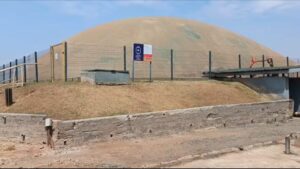
A major feature of the commemoration was a demonstration of Safisana’s circular waste management model, which converts human and organic waste into renewable electricity, organic fertilizer and treated water.
Managing Director and Founder of Safisana Ghana Limited, Mr Aart van den Beukel, said the company had processed more than 70,000 tonnes of organic and faecal waste over the past eight years through its facilities in Ashaiman and Kumasi.
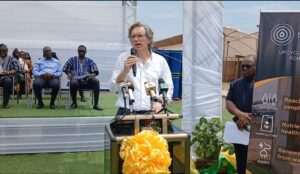
The volume, he said, was equivalent to approximately 7,000 truckloads of waste.
He disclosed that the company’s operations served more than 65,000 people annually and had created over 200 green jobs, while producing more than 335,000 bags of organic fertilizer to support agricultural production and improve soil fertility.
At the Ashaiman facility alone, more than 16,000 tonnes of faecal waste were treated in the past year, producing nearly 12,000 tonnes of organic fertilizer and generating 685 megawatt-hours of renewable electricity supplied to the national grid.
The facility employs 55 people, all Ghanaians drawn from the Ashaiman community.
Mr van den Beukel said the company’s experience demonstrated that waste treatment could become a commercially viable business while addressing public health and environmental challenges.
He traced the facility’s development from its conceptualisation in 2012, saying the model had moved beyond experimentation to demonstrate its financial and operational viability.
He announced plans to expand the capacity of the Ashaiman facility by 200 per cent to respond to increasing urban waste generation and growing demand for sustainable waste treatment services.
However, he identified regulatory delays, fragmented ministerial responsibilities, unfavourable Power Purchase Agreements (PPAs) and the absence of guaranteed markets for waste-derived products as major obstacles to expanding circular sanitation businesses.
He warned that about 90 per cent of wastewater on the African continent was discharged untreated into rivers, lakes and oceans, stressing that rapidly expanding African cities required alternatives to conventional centralised sewerage systems.
He therefore called for increased investment in decentralised waste treatment infrastructure and circular economy models.
Netherlands Backs Trade and Investment Approach
The First Secretary and Head of Economic Affairs at the Embassy of the Kingdom of the Netherlands, Mr Rens Twijnstra, reaffirmed his country’s commitment to promoting private sector investment and trade partnerships with Ghana.
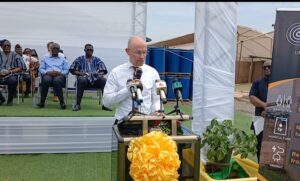
He said Safisana demonstrated how development financing could evolve into a sustainable business delivering environmental and economic benefits.
Mr Twijnstra noted that the company’s organic fertilizer production also presented opportunities for stronger Ghana-Netherlands cooperation in horticulture and agricultural development.
He said approximately 3.4 billion people globally still lacked safely managed sanitation, describing access to clean and private toilet facilities as essential to human dignity, public health and gender equality.
He particularly highlighted the importance of safe sanitation facilities in schools, where inadequate toilet infrastructure and menstrual hygiene services could undermine girls’ education and school attendance.
Representatives from the Energy Commission and the Electricity Company of Ghana also discussed regulatory arrangements and power purchase frameworks required to facilitate the integration of electricity generated from waste into the national grid.
The discussions highlighted the need for stronger institutional coordination and an investor-friendly regulatory environment to unlock financing for waste-to-energy projects.
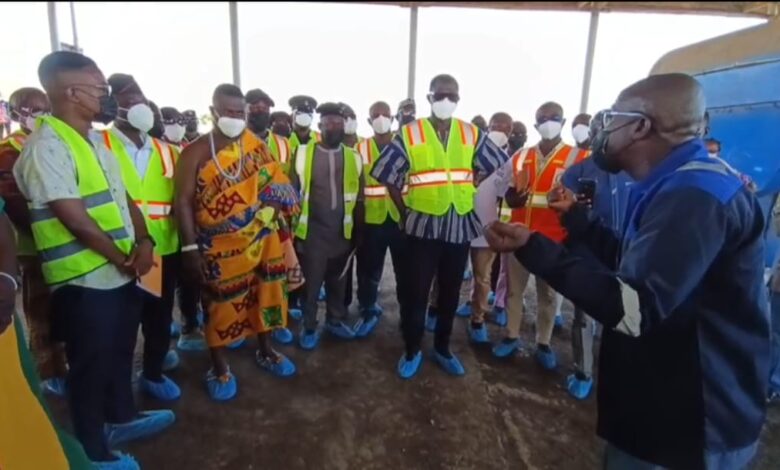
Participants subsequently toured the Safisana facility to observe its waste treatment operations, organic compost production and renewable energy processes. Schoolchildren also participated in educational demonstrations on sanitation and responsible waste management.
The pre-World Toilet Day commemoration forms part of activities leading to Ghana’s national celebration on November 19, 2026, in Bongo in the Upper East Region.
World Toilet Day, observed annually on November 19, raises awareness of the global sanitation crisis and advocates universal access to safe and sustainable sanitation facilities.
The Ashaiman engagement has renewed calls for government, financial institutions, development partners, local authorities and private investors to treat sanitation as both a public health priority and an economic opportunity capable of generating employment, supporting agriculture, producing renewable energy and improving living conditions.