
|
Getting your Trinity Audio player ready...
|
By: Samuel Asamoah
Ghanaian chief executives have been challenged to take a more active role in the country’s economic transformation by investing in local production, technology, human capital and underserved communities, rather than measuring business success solely by profits.
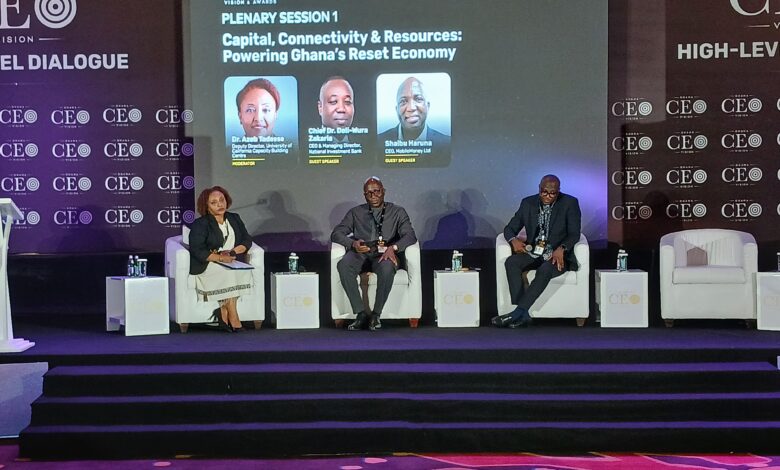
The call was made at the 5th Ghana CEO Vision High-Level Dialogue in Accra, where business executives, policymakers and development experts examined the contribution of corporate leadership to the government’s Reset Agenda.
The dialogue, held at the Kempinski Hotel Gold Coast City on Thursday, October 29, 2026, was organised under the theme, “Reimagining Ghana’s Future: CEOs at the Heart of the Reset Agenda.”
Chairman of the event, Dr Ishmael Yamson, said Ghana’s economic transformation would remain difficult to achieve if businesses continued to depend heavily on imported goods and technology instead of developing domestic productive capacity.
He challenged corporate leaders to invest in local innovation, build indigenous technological capabilities and create opportunities for Ghanaian enterprises to compete in the global economy.
Dr Yamson questioned how Ghana could achieve genuine economic independence while continuing to rely on foreign technology and imported products, despite its ambition to build a resilient economy.
He said business leaders must recognise their responsibility in the country’s development, particularly through their investment decisions, employment practices, treatment of workers and customers, and commitment to ethical corporate governance.
He also called for deliberate efforts to groom the next generation of business leaders, warning that Ghana could not expect different economic outcomes if current leaders continued making the same decisions as their predecessors.
Although acknowledging improvements in the country’s economic indicators, including the reduction in inflation and growth in economic activity, Dr Yamson stressed the need to translate macroeconomic gains into better living conditions for ordinary Ghanaians.
Private sector engagement critical to Reset Agenda
Founder and Chief Executive Officer of Ghana CEO Vision and Awards, Latif Abubakar, said government could not achieve its economic transformation objectives without meaningful participation from the private sector.

He observed that although efforts had been made to engage business leaders, their involvement in shaping the Reset Agenda remained inadequate.
Mr Abubakar said the dialogue was designed to provide a platform for chief executives to identify gaps in the country’s development priorities and offer practical solutions in areas such as innovation, job creation and local production.
He emphasised that effective governance required a strong public-private partnership in which businesses actively contributed ideas, investment and expertise to national development.
The organisers, he said, intended to develop a communiqué outlining recommendations from the discussions for submission to the Presidency.
UNESCO pushes people-centred business leadership
The Director of the UNESCO Accra Office, Edmond Moukala N’Gouemo, urged business leaders to expand their understanding of corporate success by placing human welfare and social development at the centre of their operations.
He expressed concern about persistent poverty, hunger and inequalities, particularly in rural and underserved communities where access to essential services remains a major development challenge.
Mr Moukala said businesses had an important role to play in addressing these inequalities through investments in education, healthcare, clean water, sanitation and other essential services.
He argued that corporate investment in social development should not be treated merely as philanthropy but as a strategic investment in the workforce, communities and markets that sustain businesses.
He also called on chief executives to protect workers’ rights and ensure that economic growth did not undermine human dignity.
According to him, companies cannot achieve sustainable performance when their employees and the communities in which they operate lack access to basic necessities.
Digital finance identified as growth opportunity for SMEs
Meanwhile, Chief Executive Officer of Mobile Money Fintech Limited, Shaibu Haruna, highlighted the potential of digital financial services to improve access to credit and strengthen Ghana’s small business sector.
He said digital transaction records could help financial institutions assess the financial behaviour and cash flow of entrepreneurs who lack conventional collateral or formal financial documentation.
Mr Haruna explained that small businesses, traders, farmers and young entrepreneurs could benefit from the use of digital financial histories to demonstrate their capacity to repay loans and access working capital.
He further called for stronger digital payment infrastructure to support the government’s 24-hour economy initiative, noting that businesses required reliable payment systems to operate efficiently beyond conventional working hours.
He also highlighted the importance of financial literacy, local fintech innovation and customer education in ensuring that digital financial services translated into meaningful economic opportunities.
Corporate leadership and national development
The discussions also featured a session on “People, Skills and Services: Building the Human Engine of the Reset”, which brought together business leaders, including Dr Daniel McKorley of McDan Group, and other experts to examine the importance of skills development and human capital in Ghana’s economic transformation.
The dialogue reinforced calls for stronger collaboration between government, businesses and development institutions to address structural challenges affecting the economy.
With local industrialisation, technological innovation, employment creation and social inclusion emerging as key priorities, participants emphasised the need to translate corporate commitments into measurable development outcomes.
The Ghana CEO Vision and Awards platform seeks to recognise outstanding business leadership while providing opportunities for high-level engagement, knowledge exchange and partnerships among corporate executives and other stakeholders.
The 2026 dialogue therefore placed renewed attention on the responsibility of Ghanaian businesses to complement government policies with investments and practical interventions capable of driving inclusive and sustainable economic growth.