
Ghana Strengthens Energy Security with Commissioning of MT Asharami Ghana LPG Vessel

|
Getting your Trinity Audio player ready...
|
By Justice Ahoto
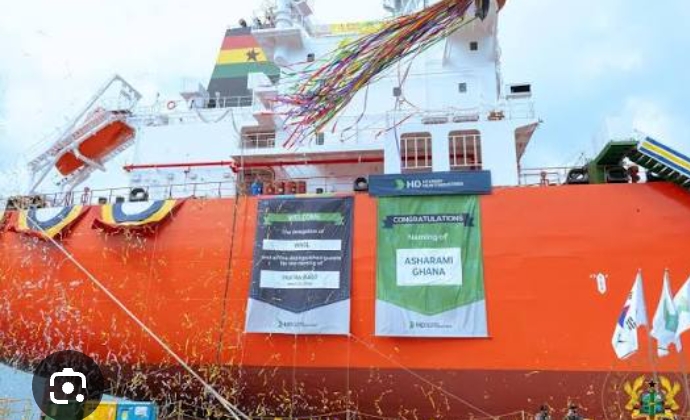
Ghana has taken a significant step toward strengthening its energy security and improving access to cleaner household fuel with the commissioning of the liquefied petroleum gas (LPG) vessel MT Asharami Ghana in South Korea.
The commissioning ceremony was led by President John Dramani Mahama, who described the vessel as a strategic investment that will enhance Ghana’s capacity to transport LPG safely and efficiently while supporting the country’s growing energy demand.
The development comes at a time when Ghana and many countries across West Africa are expanding efforts to improve access to modern energy sources, particularly LPG, which is widely promoted as a cleaner alternative to charcoal and firewood for cooking.
Ghana’s Growing Demand for LPG
In recent years, Ghana’s LPG consumption has increased steadily due to urbanization, industrial growth, and government initiatives encouraging households to switch from traditional biomass fuels to cleaner cooking options.
Despite this growth, Ghana currently produces only about half of its LPG requirements domestically. The remaining demand is met through imports, which require efficient maritime transportation and storage infrastructure.
The introduction of MT Asharami Ghana is expected to play a key role in bridging this gap by strengthening the logistics chain that delivers LPG to Ghanaian markets.
Speaking at the ceremony, President Mahama highlighted the vessel’s importance to both national development and regional energy cooperation.
“This LPG vessel will strengthen our collective ability to transport LPG safely, efficiently, and at scale,” he said, noting that the initiative will support economic growth and improve the quality of life for millions of people.
Strategic Partnerships Driving Energy Infrastructure
The commissioning of the vessel reflects growing collaboration between African energy companies and international partners seeking to close critical infrastructure gaps.
The project was developed through a partnership involving Sahara Group and WAGL Energy, alongside other stakeholders in the energy and maritime sectors.
Industry analysts say such partnerships are essential for scaling up Africa’s energy infrastructure, particularly in the downstream petroleum sector where logistics and distribution systems are often constrained.
By expanding maritime transport capacity, the vessel is expected to improve LPG supply reliability not only in Ghana but also across neighboring West African markets that depend on imported fuel.
Supporting Clean Energy Transition
The move also aligns with Ghana’s broader efforts to promote cleaner energy use and reduce environmental degradation caused by traditional cooking fuels.
Government policies encouraging LPG adoption aim to reduce deforestation and indoor air pollution while improving public health outcomes, especially for women and children who are most exposed to smoke from firewood and charcoal.
With the addition of MT Asharami Ghana, experts believe Ghana will be better positioned to meet rising LPG demand while strengthening regional energy supply networks.
Positioning Ghana as a Regional Energy Hub
Beyond meeting domestic needs, the vessel represents part of a broader vision to position Ghana as a logistics and energy hub within the West African sub-region.
With its strategic coastal location and growing petroleum infrastructure, Ghana has increasingly become a key player in regional fuel supply and distribution.
The commissioning of MT Asharami Ghana therefore signals not only an investment in energy transportation capacity but also a step toward deeper regional cooperation in energy trade.
As demand for reliable and cleaner energy sources continues to grow across Africa, investments like this are expected to play a critical role in strengthening supply chains, supporting economic development, and improving access to modern energy services for millions of people.