
|
Getting your Trinity Audio player ready...
|
By Christian Ahodie Yaw
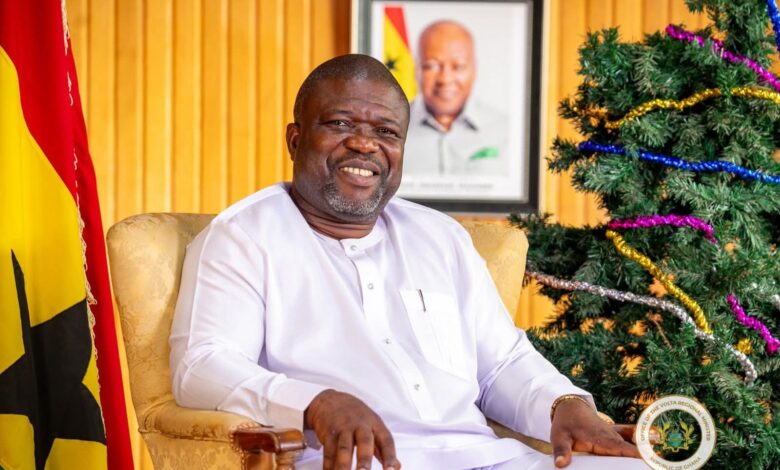
One year into the tenure of Volta Regional Minister, Hon. James Gunu, the region presents a mixed but largely progressive development narrative—defined by renewed policy direction, ambitious plans, and early-stage implementation across key sectors. While government-led assessments point to notable gains, a closer look reveals a leadership period marked as much by promise as by the challenge of translating vision into lasting, people-centred outcomes.
From February 2025 to January 2026, the Volta Regional Coordinating Council (VRCC) reports activity in infrastructure, agriculture, water and sanitation, education, health, tourism, youth development, and governance. The extent to which these initiatives will reshape livelihoods, however, remains the central question as the administration moves into its second year.
Economic Ambition and Regional Repositioning
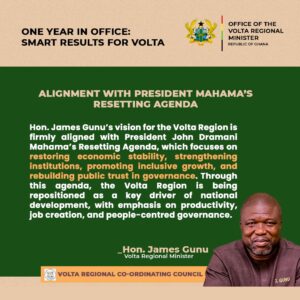
Hon. Gunu assumed office on February 3, 2025, at a time when expectations were high for regional ministers to align local development with President John Dramani Mahama’s broader economic reset and the proposed 24-Hour Economy Policy. In Volta, this translated into an overt attempt to reposition the region as a production, trade, and logistics hub.
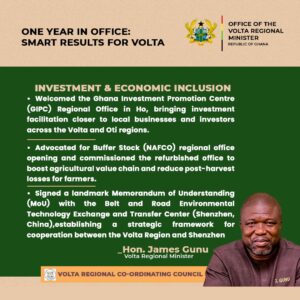
The Volta Trade and Investment Fair, hosted in Juapong, became a key platform for articulating this ambition. The fair’s theme, “Volta Rising: Building Global Partnerships for a Thriving 24-Hour Economy,” captured the administration’s intent to attract investors and revive dormant industrial assets such as Juapong Textile Limited. Plans for a 1,500-acre industrial park in Adaklu were also announced, aimed at supporting manufacturing and logistics.
Yet, beyond policy statements and investment pitches, tangible timelines, financing structures, and job projections for these flagship ideas are still evolving, leaving residents and analysts awaiting clearer indicators of economic transformation at scale.
Infrastructure: Incremental Gains, Persistent Gaps
Infrastructure development remains a central pillar of the region’s growth strategy. The administration has maintained oversight of key road projects, including sections of the Eastern Corridor Road, and has repeatedly cautioned contractors against substandard work.
Projects such as the Volivo Bridge, feeder road upgrades, and proposals around the Volta Lake Economic Corridor signal a long-term vision for improved connectivity, agribusiness expansion, and tourism growth. However, many of these interventions are either ongoing or at planning stages, underscoring the reality that infrastructure impact is cumulative and often slower than public expectation.
Agriculture and Food Security
Agriculture received targeted attention, particularly through irrigation support. The distribution of 100 water-pumping machines under the Feed Ghana Programme and the Volta Lake Economic Corridor initiative reflects a shift toward productivity-driven interventions rather than seasonal support.
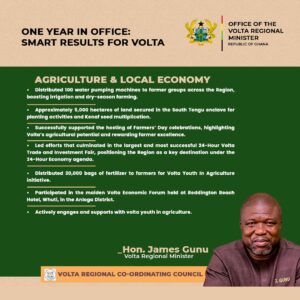
Hosting the 41st National Farmers Day celebrations placed Volta in the national spotlight and offered farmers and agribusinesses a platform for visibility and networking. Meanwhile, discussions around a proposed cocoa processing facility in Hohoe suggest a policy preference for value addition. As with many such proposals, the key test will be investor commitment and project execution.
Water and Sanitation: Policy Dialogue versus Ground Reality
Water security emerged as a politically sensitive and socially urgent issue during the year. The regional minister convened a high-level dialogue on resilient water and sanitation systems, bringing together state agencies, local authorities, and civil society.
While these engagements indicate political will, communities facing chronic water shortages continue to expect durable solutions. Interim water supply measures and coordination with Ghana Water Company engineers have offered relief in some areas, but systemic challenges persist.
Health and Education: Expanding Access, Awaiting Outcomes
Health and education infrastructure saw multiple sod-cutting and commissioning exercises across districts, including CHPS compounds in Agorgbe and Lolito/Nyinuito, classroom blocks in South Tongu, and expanded school facilities in North Tongu.
At the tertiary level, discussions around a potential $280 million expansion of the Ho Teaching Hospital—including advanced medical units—signal ambition. However, these plans remain at the feasibility and partnership negotiation stage, with funding and implementation yet to be secured.
Tourism, Youth, and Skills Development
Tourism development under Hon. Gunu has focused on identifying underutilised cultural and natural assets, particularly around the Volta Lake and mountainous zones. Planning and stakeholder engagement are ongoing, though significant infrastructure investment will be required to unlock the sector’s economic potential.
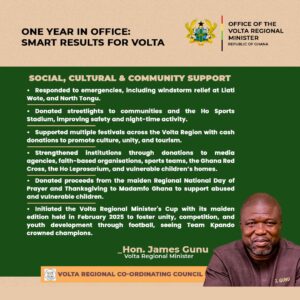
Youth development initiatives, especially in sports, have been more visible. Support for regional football and the installation of floodlights at the Ho Sports Stadium have been welcomed, as have community-based skills programmes like the Ho-Hliha Community Centre. These efforts, while modest in scale, address youth inclusion beyond formal education.
Governance, Partnerships, and Security
Governance under the current administration has emphasised partnerships. Engagements with traditional authorities, civil society, foreign missions, and financial institutions such as Republic Bank Ghana point to a consultative approach.
High-profile proposals, including the Keta Port Project, have been positioned as transformational, though they remain subject to national policy decisions, environmental considerations, and financing constraints.
An Assessment in Progress
After one year, Hon. James Gunu’s leadership in the Volta Region reflects a clear policy direction and strong emphasis on stakeholder collaboration. The administration has laid groundwork across sectors, initiated dialogue, and signalled intent to reposition the region economically.
Yet, as with many first-year governance assessments, the distinction between announced initiatives and lived impact is crucial. The coming years will determine whether the plans outlined mature into sustained development outcomes that measurably improve livelihoods across the region.
For now, the Volta Region stands at an inflection point—armed with ambition, cautiously optimistic, and facing the enduring challenge of delivery.